

Infiltration Watch Briefing: Issue 1
Welcome to the first issue of Infiltration Watch. Here is what happened in just the last seven days:
Two agents of China’s Ministry of State Security were sentenced for spying on the U.S. Navy.
Oracle canceled a $7 billion deal to rent advanced American AI chips to Tencent.
Google found that a Chinese manufacturer had built a backdoor into more than 1.3 million TV boxes.
The FCC moved to end China’s hold on testing the electronics Americans buy, and Beijing threatened to retaliate.
A Stanford student told how a suspected Chinese intelligence operative posing as a classmate tried to get her to Shanghai.
China’s embassy in Papua New Guinea expects us to believe that a live artillery shell is a wine bottle.
Each of these should be a major story, but how many did you see this week?
Most people saw one or two of them at most. And that is exactly why we started Infiltration Watch.
Every week we gather what reporters across the country have found on the Chinese Communist Party’s activity inside the United States and put it in one place, so you can see the whole picture.
So, here we go…
1. Two Chinese agents get 30 months for targeting the U.S. Navy
Liren “Ryan” Lai, 40, and Yuance Chen, 39, were each sentenced on Oct. 30 to 30 months in federal prison and three years of supervised release. Both pleaded guilty to conspiring to act, and acting, as agents of the People’s Republic of China without notifying the Attorney General.
According to court documents, the two had worked for China’s Ministry of State Security (MSS) since at least May 2021. Lai recruited Chen and acted as his go-between with MSS officers. Their assignment was to gather information on U.S. Navy personnel and bases and to recruit service members as sources. In 2022, working from China, they arranged for about $10,000 in cash to be left in a backpack in a locker at a recreation center in Livermore, California. In all, they admitted to facilitating at least $30,000 in these dead-drop payments.
They were arrested in June 2025. The charges carried up to 10 years each. Judge Jon Tigar of the Northern District of California gave them two and a half.

Read more: Justice Department · Courthouse News
2. Oracle walks away from a $7 billion AI chip deal with Tencent
Oracle has canceled a five-year lease that would have given Tencent access to about 100,000 advanced AI chips in Oracle data centers in Southeast Asia, the Financial Times reported on Nov. 4. The deal was worth an estimated $7 billion, with about 30 percent paid upfront.
These are chips Tencent cannot buy in China. Export controls govern where chips are shipped, so renting them in a data center outside China was allowed under the current rules. U.S. officials raised concerns with Oracle anyway, and Oracle pulled out. Beijing was pushing from its side too: officials from Guangdong province, where Tencent is based, visited the company and urged it to use Chinese-made chips. Tencent is also on the Pentagon’s list of Chinese military companies.
The same week, the FT reported that Nvidia told its cloud customers to sell at least 51 percent of their capacity to non-Chinese companies. ByteDance and Alibaba still have large chip-leasing deals with U.S. cloud providers, and Oracle supplies ByteDance from data centers in Malaysia. So the door has closed on Tencent. ByteDance’s is still open in Malaysia.
As Jennifer Wu summed it up well on X, Chinese firms keep finding workarounds, and Washington is starting to close them one at a time.

Read more: Financial Times · Reuters
3. A Chinese factory shipped more than 1.3 million TV boxes with a backdoor built in

Google reported on Nov. 2 that Videostrong Technology, a Chinese maker of Android TV set-top boxes, deliberately built a backdoor into its devices’ firmware and ran the resulting network of hijacked boxes for profit. More than 1.3 million boxes were enrolled. Google found the same malware in some telehealth devices, karaoke machines and digital signs.
Videostrong sold access to the boxes to criminal partners, who used them for ad fraud, rented out their owners’ home internet connections to strangers, and loaded more malware. Google says Videostrong’s own operators also took live screenshots, injected keystrokes and pulled account information from devices. The software runs with system-level control, switches off Google Play Protect, and reinstalls itself if the owner deletes it. It slipped past Google’s certification tests by staying dormant until after the box was first switched on.
Google and its partners, including Japan’s National Police Agency, took down the servers that controlled the boxes. Google says that also cuts criminals off from at least 10 million other infected devices. Videostrong is now banned from certified Android. The backdoor itself stays in the firmware of every box already sold.
Google found the motive was money. China’s 2017 National Intelligence Law requires Chinese companies to assist state intelligence work when asked. A company that already sells access to a million living rooms would not take much asking.
If you own a cheap streaming box from a brand you don’t recognize, check it against Google’s list of certified Android TV partners. Google also warns against any app that offers to pay you for your “unused bandwidth.”
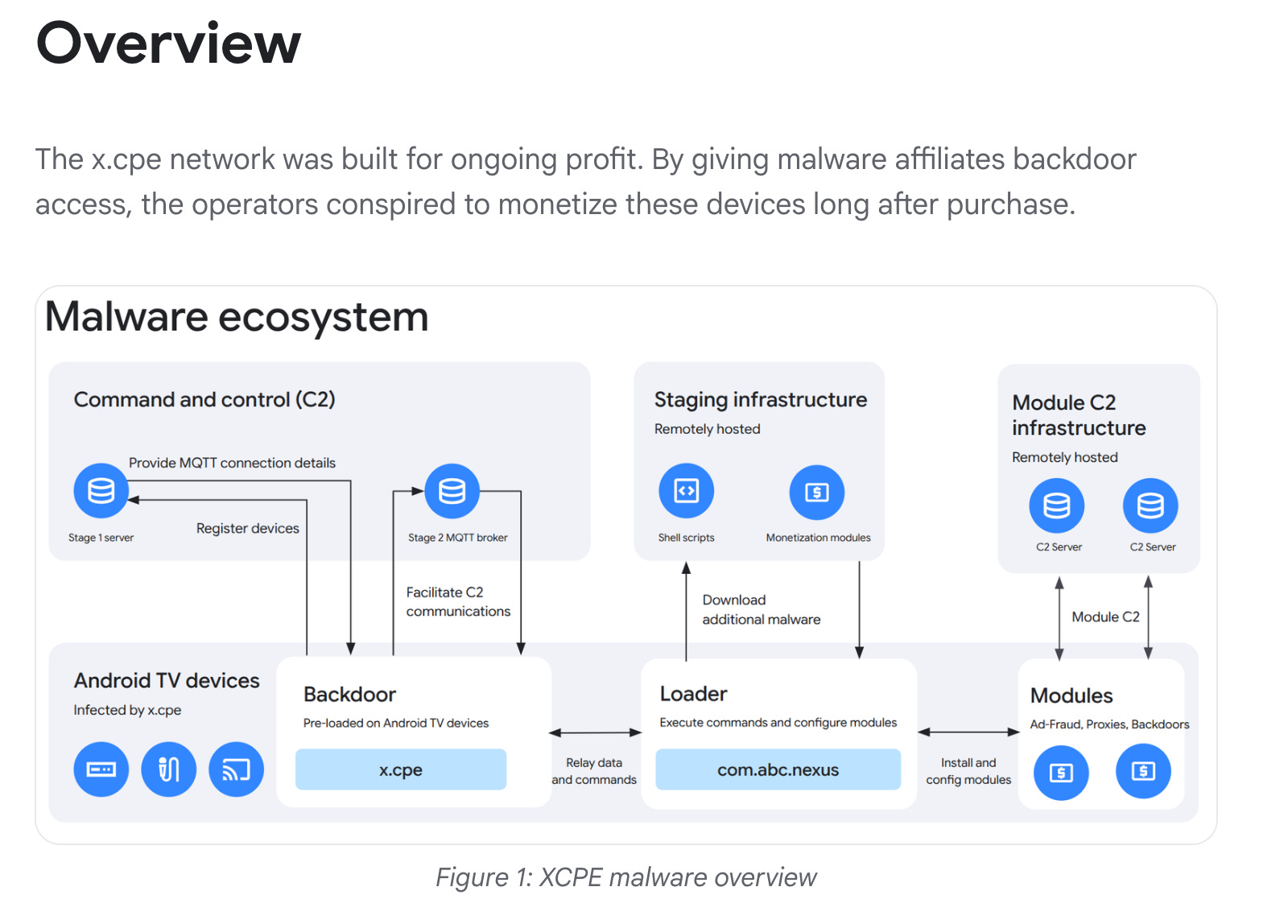
Read more: Google Threat Intelligence report
4. Beijing wants the U.S. to keep using its testing labs

On Oct. 29, the FCC voted to stop recognizing electronics testing labs, certification bodies and accreditation bodies in countries that don’t give U.S. labs the same access. Every phone, laptop, camera and router sold in America has to pass through an FCC-recognized lab first. FCC Chairman Brendan Carr says about 82 percent of devices sold or used here in 2025 were tested in mainland China, and fewer than 4 percent in the United States. American labs get no equivalent access to the Chinese market. Because China does not recognize U.S. labs, its labs will lose FCC recognition. Manufacturers have until Dec. 1, 2028, to move their testing to labs in the U.S. or in countries that offer the same access in return.
China’s Commerce Ministry responded the next day. It demanded the rules be revoked immediately, said they violated an important consensus between the two countries’ leaders, warned they would disrupt global supply chains, and promised further countermeasures if the U.S. insists on going its own way. It also said it had offered talks on mutual recognition and found Washington “extremely passive and negative.”
Beijing had already retaliated once. In August it put Compliance Testing LLC, an American lab whose CEO had publicly supported the rule, on its countermeasure list and barred Chinese companies from doing business with it.
The ministry is objecting to losing access it has never offered in return. The rule already says how China can keep its labs in the American market: open its own market to American labs.
Read more: FCC order · South China Morning Post · DroneXL
5. A suspected Chinese agent posed as a Stanford student for years

On June 10, 2024, Stanford freshman Elsa Johnson got an Instagram message from a man calling himself Charles Chen. He said he was a Stanford international student. His profile was full of campus photos, and they had friends in common. Johnson had learned Mandarin in elementary school and was researching Chinese industry and military tactics at the Hoover Institution on campus.
Chen soon offered her a paid trip to Shanghai and pressed her to move their conversation to WeChat, an app monitored by Chinese state security. He seemed to know things about her she had never told him. When she pulled back, she began getting threatening phone calls from Chinese speakers.
She went to Stanford and the FBI. She was told Chen had no connection to Stanford, was likely working for China’s Ministry of State Security, had probably posed as a student for years, and had targeted at least 10 other female students since 2020. She was also told she was under physical surveillance on campus. In March 2026 she testified before the House Committee on Education and the Workforce, and said Stanford had been reluctant to act.
Johnson first wrote about the case in The Stanford Review and The Free Press. This week she told the full story on episode 270 of the Spycraft 101 podcast. The approach she describes is simple: a friendly message, a free trip, and a request to switch to an app Beijing can read. It can be aimed at any student researching China, on any campus in the country.
Read more: Daily Wire on her testimony · The Free Press
And finally…
6. The 32-kilogram wine bottle

On Oct. 29, a contractor in Port Moresby, Papua New Guinea, was going through a shipping container of building materials and found something green, heavy and shaped exactly like an artillery shell. Police arrested four Chinese nationals the next day.
The Chinese embassy had an explanation. It said the company involved had checked, and the object was a shell-shaped wine bottle that posed no danger at all. It added that China’s strict gun laws made it virtually impossible for a military shell to be smuggled out of the country.
Police and army bomb technicians X-rayed it with a machine Australia had donated. It was a 130mm Chinese Type 59 artillery projectile, complete with explosives and a fuse. Police Commissioner David Manning confirmed on Nov. 5 that it was a 130mm military round. The U.S. Embassy in Australia added, for anyone still unsure, that it was not a wine bottle.
A standard bottle of wine weighs about 1.2 kilograms. This one weighed 32, which makes it about 26 bottles of wine, with a fuse.
In China, an official can say something like this and no one is in a position to argue. The embassy in Port Moresby seems to have expected the same courtesy abroad, but we aren’t in China and PNG had an X-ray machine to prove a point.
Read more: ABC News · Infiltration Watch on X

Never Miss a Story
Subscribe to Infiltration Watch and get every week’s stories in your inbox every Friday. If you know someone who should be paying attention, forward this to them. You can also follow @infil_watch on X for stories as they break.